Chart journal guide · 4 min
How to review your transit notes
Keep observations, expectations, actions and outcomes separate. A practical method for reviewing astrology notes without forcing a pattern.
By PlainAstro · Updated 2 November 2026
Every entry and outcome below is invented to demonstrate a review method. No event is being predicted or attributed to a planetary placement.
The useful part of a journal often happens when you return to it. Reading an old expectation beside an actual outcome can reveal what you noticed accurately, what was vague, and what needs a different explanation.
Separate four things
- Context: the transit or chart question you are studying, with dates checked separately.
- Observation: what actually happened, in ordinary language.
- Action: what you chose to do.
- Outcome: what you found when you came back.
Keeping these separate makes it harder to accidentally describe an expectation as an event. It also keeps your own actions visible in the record.
Decide what you will review in advance
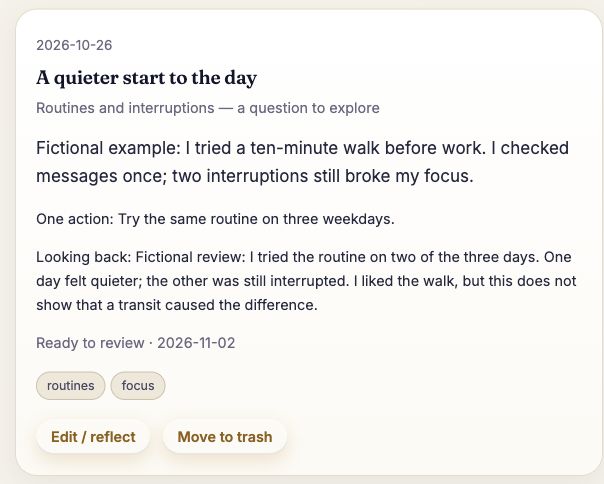
For the morning-routine example, the action is “Try the same routine on three weekdays.” A useful review asks how many times the routine happened and whether interruptions changed. It does not require the result to be positive.
Example review · 2 November 2026
What changed, and what did not?
“I tried the routine on two of the three days. One day felt quieter; the other was still interrupted. I liked the walk, but this does not show that a transit caused the difference.”
Use the review filter and tags
In the journal, choose Show → Ready to review to see entries whose review date is today or earlier. Choose Edit / reflect, add what you found, and press Save changes.
Use a small set of tags you can apply consistently: for example, routines, conversations or creative work. Search notes or tags to bring related observations together. Your observations are grouped by the chart selected at the top of the journal.
Keep the misses in the record
Record ordinary days, expectations that did not match, and periods when you did not follow the planned action. Otherwise, a collection can gradually become a list of memorable matches rather than a balanced record.
Note everyday influences such as deadlines, travel or a change in routine. You do not need to force an event into a sign, house or aspect interpretation.
Know what this journal does
PlainAstro keeps your chart beside dated notes. Transit context is entered by you; the journal does not verify the label, send your notes to AI, or test whether astrology caused an outcome. Review dates are an in-app filter, not a notification service.
For the setup steps, read how to start an astrology journal. For keeping a separate copy of your notes, read the saving and backup guide.